Sales Automation Mistakes That Lower Reply Quality
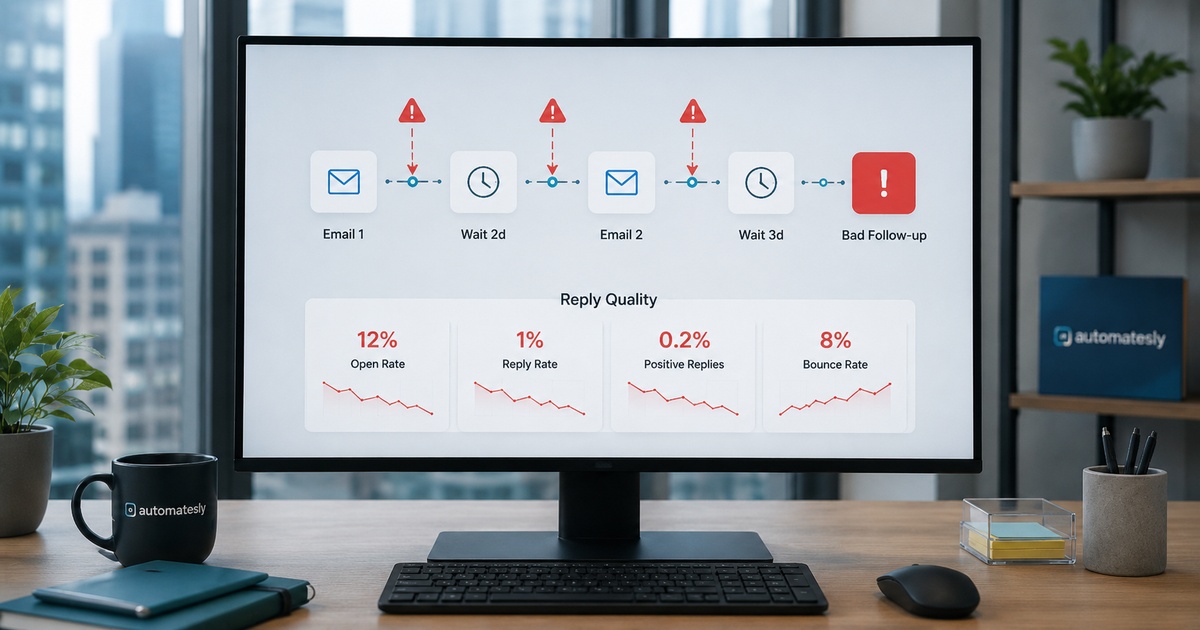
Sales automation is supposed to get you more replies with less effort. Done badly, it does the opposite: it lets you send more bad outreach faster, training prospects to ignore you and dragging your reply quality down even as your activity numbers climb. The tools are not the problem; the habits are. Most reply-killing mistakes are predictable and fixable once you see them. Here are the sales automation mistakes that quietly lower reply quality, and how to automate in a way that still sounds like a person worth replying to.
Why automation can lower reply quality
Automation amplifies whatever you feed it. If your targeting and messaging are good, it amplifies good outreach; if they are mediocre, it amplifies mediocrity at scale, and prospects notice. The core tension is that automation pushes toward volume while good replies come from relevance, and chasing the former usually sacrifices the latter. Worse, the metrics tempt you down the wrong path: it is easy to feel productive watching thousands of emails send, while reply quality, the thing that actually matters, quietly collapses. Recognising that more sent does not mean more won is the starting point for avoiding the mistakes below.
The mistakes that kill replies
These are the recurring habits that drag reply quality down, in rough order of how much damage they do.
- Generic mass sending: the same barely-personalised message to a huge list, instantly recognisable as spam and ignored.
- Fake personalisation: a token first name or company in an obviously templated message, which reads as more insincere than no personalisation at all.
- Wrong targeting: contacting people who have no plausible need, so even a good message fails and your reputation suffers.
- Over-automation of replies: automated follow-ups that ignore what the prospect actually said, breaking the conversation.
- Volume over warm-up: scaling sending faster than your infrastructure and reputation can handle, landing you in spam.
- No human handoff: interested replies sitting in an automated sequence instead of reaching a person quickly.
What good automation looks like
Good sales automation removes the repetitive work around outreach while keeping the human relevance that earns replies. It automates the right things, finding and enriching leads, scheduling and sending, following up on non-responses, logging activity, while leaving genuine personalisation and real conversations to humans. It targets tightly rather than broadly, so each message has a real reason to exist. And it treats an interested reply as a signal to bring in a person fast, not to continue a robotic sequence. The aim is leverage on the busywork, not automation of the relationship, the same principle behind a well-built AI sales stack.
The personalisation balance
The hardest part is personalisation at scale, and most teams get the balance wrong in one of two directions. Too little, and outreach is obviously generic spam. Too much fake personalisation, the mail-merged “I loved your recent post” that clearly nobody read, is arguably worse, because it signals effort to deceive. The honest middle is to personalise on things that are both true and relevant, segment-level relevance done well often beats shallow individual tokens, and to be genuine rather than performatively personal. A clear, relevant, honest message to a well-chosen prospect outperforms a fake-personalised one to a poorly-chosen one every time. Good lead enrichment helps you personalise on what actually matters rather than on superficial tokens.
How to fix a sequence that has gone stale
If your reply rates have been sliding, the instinct is to send more or tweak subject lines, but the fix usually lies deeper. Start with targeting: pull a sample of who you have been contacting and ask honestly whether each person had a plausible reason to care. A tighter, smaller list of genuinely relevant prospects almost always lifts reply quality more than any copy change, because relevance is the lever, not cleverness.
Next, read your own messages as a prospect would. If the personalisation is obviously templated, or the message could have been sent to anyone, rewrite it to say something true and specific to that segment. Then check the mechanics: is an interested reply actually reaching a human quickly, or sitting in an automated follow-up that ignores it? Are your follow-ups adding value or just nagging? Often the highest-impact change is simply slowing down, contacting fewer, better-chosen people with clearer, more honest messages, and getting humans onto warm replies fast. Volume problems are rarely solved by more volume.
Frequently asked questions
Why do my automated outreach reply rates keep dropping?
Usually because automation is amplifying weak targeting or generic messaging at scale, which prospects quickly learn to ignore, while activity metrics make it feel productive. Common culprits are mass sending barely-personalised messages, fake personalisation, contacting people with no plausible need, robotic follow-ups that ignore replies, and scaling volume faster than your reputation can handle. Reply quality comes from relevance, not volume, so more sending often makes it worse, not better.
Is personalisation or volume more important in outreach?
Relevance beats volume for reply quality. A clear, honest, relevant message to a well-chosen prospect outperforms a fake-personalised one blasted to a poor list. The trap is that volume is easy to scale and feels productive, while relevance takes targeting and restraint. Fake personalisation, the obviously templated “I loved your post,” is worse than none. Personalise on things that are both true and relevant, and target tightly rather than broadly.
How do I automate sales outreach without sounding like a bot?
Automate the busywork, finding and enriching leads, scheduling, following up on non-responses, logging activity, while keeping genuine personalisation and real conversations human. Target tightly so each message has a real reason to exist, personalise on what is true and relevant rather than superficial tokens, and route interested replies to a person quickly instead of continuing a robotic sequence. The goal is leverage on the admin, not automation of the relationship itself.
Does sales automation hurt or help reply rates?
It does whichever you set it up to do. Automation amplifies your targeting and messaging, so good outreach scales into more replies and weak outreach scales into more spam that prospects ignore. Used to automate the busywork, finding leads, scheduling, following up, logging, while keeping personalisation and conversations human, it helps. Used to blast generic, barely-personalised email at a broad list, it actively lowers reply quality even as activity numbers rise.
How do I write better cold outreach that gets replies?
Target tightly so each message has a real reason to exist, then say something true and specific to that segment rather than relying on a templated first-name token. Keep it short, clear, and honest about why you are reaching out and what you want. Make following up easy and route any interested reply to a human fast. Relevance and honesty earn replies; volume and fake personalisation erode them, so favour fewer, better messages.

Written by gautam995576@gmail.com
AI automation editor focused on workflow design, tool selection, privacy checks, and operational clarity.
Related automation guides
Marketing Automation in 2026: What Is Ready and What Still Needs Humans
Where marketing automation genuinely delivers in 2026 and where it still needs a human, so you automate the right work and keep…
AI Content Operations Workflow for Small Marketing Teams
How a small marketing team can build an AI content workflow that keeps quality high: roles, review steps, and where AI helps…
The Practical AI Sales Stack for Small B2B Teams
A realistic AI sales stack for small B2B teams: which tools earn their place, how the pieces fit together, and where to…