AI Recruiting Tools Buyer Guide for Hiring Teams
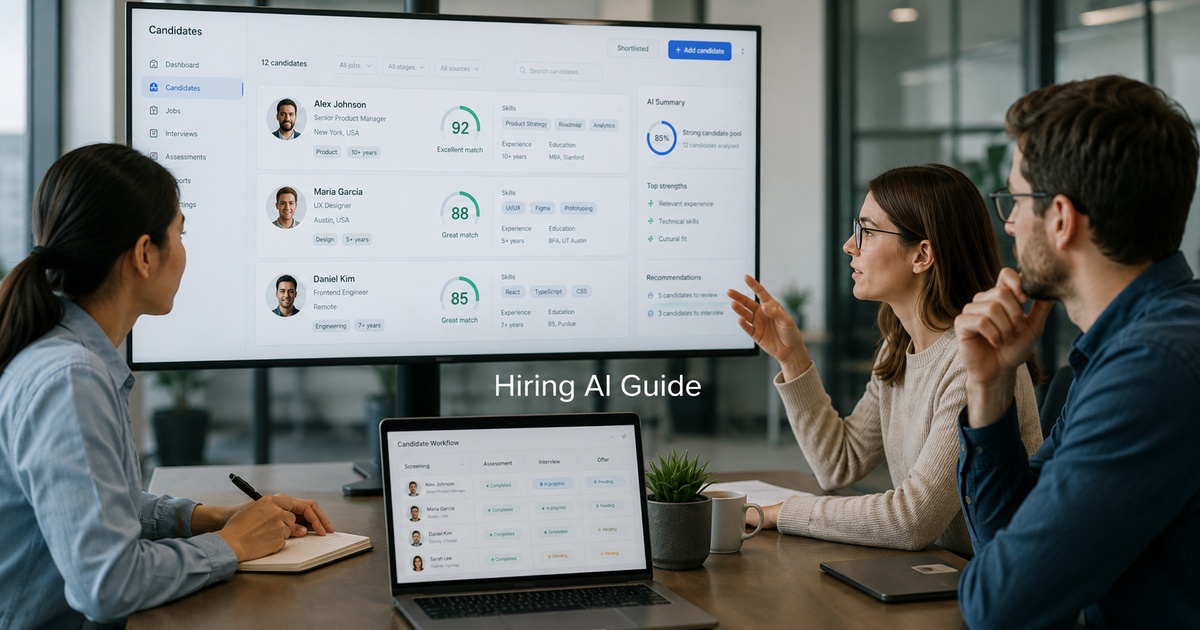
AI recruiting tools promise to speed up hiring, sourcing candidates, screening applications, scheduling interviews, and more, and for high-volume hiring the time savings are real. They also carry risks that most software does not, because decisions about people’s careers touch fairness, bias, and the law in ways a hiring team cannot afford to get wrong. The right approach is to adopt these tools with clear eyes: useful for the right tasks, managed carefully for the wrong ones, and never trusted to make hiring decisions on their own. Here is a practical buyer’s guide for hiring teams.
What AI recruiting tools actually do
AI shows up across the hiring funnel, and it helps to separate where it genuinely saves time from where it makes consequential judgements. On the lower-risk end, AI handles sourcing and outreach, parsing and organising applications, scheduling interviews, and answering candidate questions, real efficiency gains with limited downside. On the higher-risk end, AI is used to screen, rank, or assess candidates, which directly affects who advances and is where fairness, bias, and legal concerns concentrate. Keeping this distinction front of mind is the single most useful thing when evaluating tools, because the buying decision and the caution required differ sharply between the two.
Categories of AI recruiting tools
The market spans several categories, each with a different risk profile.
- Sourcing and outreach: finding and contacting candidates, mostly efficiency, lower risk.
- Application management: parsing resumes and organising applicants, helpful and relatively low-risk if it informs rather than decides.
- Screening and ranking: scoring or filtering candidates, the highest-risk category for bias and fairness.
- Scheduling and coordination: automating interview logistics, low-risk and candidate-friendly when done well.
- Assessment: evaluating skills or fit, which needs careful scrutiny for validity and fairness.
How to evaluate AI recruiting tools
Weigh the usual fit factors, but put fairness and accountability at the centre.
- What it decides versus informs: prefer tools that assist human decisions over ones that filter people out automatically.
- Bias and fairness: what the vendor can show about how they test for and mitigate bias.
- Transparency: can you understand and explain why it surfaced or scored a candidate a certain way?
- Compliance: does it help you meet the hiring regulations that apply where you operate?
- Candidate experience: does it treat applicants like people, not just data to be processed?
The risks to manage
The defining risk of AI in recruiting is that it can encode and scale bias. A screening tool trained on past hiring can learn and amplify historical patterns, disadvantaging groups at scale and far less visibly than an individual human would, and because it does so consistently, the impact is large. There is also a legal dimension: hiring is regulated, and using AI in ways that produce discriminatory outcomes can create serious liability, with rules in this area evolving. And there is the candidate-experience risk of treating people as data to be filtered. None of this means avoid AI recruiting tools, but it does mean the screening end demands genuine scrutiny, which is why understanding resume screening AI risks matters before you let any tool filter applicants.
Fairness, compliance, and keeping humans in charge
Adopt AI recruiting tools in a way that keeps fairness and human judgement central. Favour AI that assists human decisions, surfacing, organising, summarising, over AI that autonomously rejects candidates, and keep a human making the actual advancement decisions, especially anything consequential. Ask vendors hard questions about bias testing and be sceptical of vague reassurance. Understand the hiring laws where you operate and how a tool affects compliance, and because this is a legal area, involve HR and legal professionals rather than relying on a vendor’s claims. Used for efficiency with humans firmly in charge of decisions, AI recruiting tools help; used to automate judgements about people without oversight, they are a fairness and legal hazard. This is general information, not legal advice; consult qualified professionals for your situation.
How to roll out AI recruiting tools
When you do adopt AI in hiring, roll it out in a way that matches each tool to its risk. Start with the low-risk, high-return uses, scheduling and coordination, sourcing, application organisation, where the efficiency is real and the downside limited, and get comfortable with those before going anywhere near automated screening. The candidate-friendly end, like interview scheduling automation, is an easy early win that improves the experience for applicants rather than putting them at risk.
For the higher-risk uses, screening, ranking, assessment, proceed with real caution and human oversight, keeping people accountable for who advances, as our look at resume screening AI risks details, and run any tool that will touch candidate data through a proper security review first. The pattern that works is to let AI handle logistics and volume while humans keep the judgement, monitor for fairness as you go, and involve HR and legal before relying on any tool for consequential decisions. Adopt the easy wins quickly and the consequential capabilities slowly.
Frequently asked questions
What do AI recruiting tools do?
They apply AI across the hiring funnel: sourcing and contacting candidates, parsing and organising applications, scheduling interviews, answering candidate questions, and, more contentiously, screening, ranking, or assessing candidates. The lower-risk uses are efficiency gains with limited downside; the screening and assessment uses make consequential judgements about people and concentrate the fairness, bias, and legal risks. Separating those two categories is the most useful lens when evaluating tools.
Are AI recruiting tools biased?
They can be, which is their defining risk. Screening tools trained on past hiring can learn and amplify historical bias, disadvantaging groups at scale and less visibly than an individual would. That does not make all AI recruiting tools unusable, lower-risk uses like scheduling and sourcing carry little of this danger, but the screening and ranking end demands genuine scrutiny of how a vendor tests for and mitigates bias, transparency into decisions, and a human making the actual calls. Treat vague reassurance with scepticism.
How should hiring teams use AI recruiting tools safely?
Favour tools that assist human decisions, surfacing, organising, summarising, over ones that autonomously reject candidates, and keep a human making advancement decisions. Use AI freely for low-risk efficiency like scheduling and sourcing, but scrutinise screening and assessment for bias, transparency, and compliance. Understand the hiring laws where you operate and involve HR and legal professionals rather than trusting vendor claims. Adopt the low-risk efficiency wins quickly and the consequential screening capabilities slowly, keeping a human accountable for every decision that affects who actually gets hired or rejected. This is general guidance, not legal advice; consult qualified professionals for your specific situation.

Written by gautam995576@gmail.com
AI automation editor focused on workflow design, tool selection, privacy checks, and operational clarity.
Related automation guides
Interview Scheduling Automation That Candidates Actually Like
How to automate interview scheduling without making candidates feel processed: the setup, the human touches, and the friction points worth removing.
Resume Screening AI Risks and Safer Review Practices
Resume screening AI can introduce bias and miss good people. The real risks, what the rules expect, and safer review practices that…