How to Measure Support AI Deflection Honestly
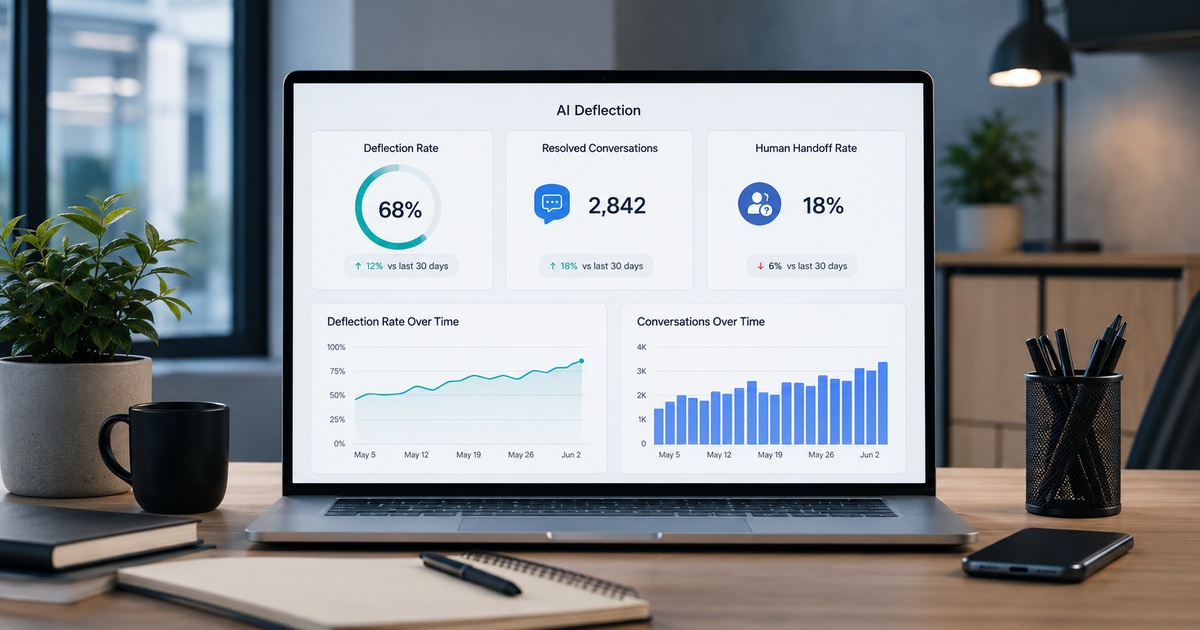
“Our AI deflects sixty percent of tickets” is the kind of number that sells support AI and quietly misleads the people who buy it. Deflection is one of the easiest metrics to inflate and one of the most dangerous to trust blindly, because a high deflection rate can mean your AI is brilliantly resolving issues, or that frustrated customers are giving up. If you cannot tell the difference, your headline number is worse than useless. Measuring support AI honestly means looking past deflection to whether customers actually got helped. Here is how to do that.
Why deflection is so easy to fake
Deflection usually means a customer interaction that did not become a human ticket, and that definition hides a multitude of sins. A conversation counts as “deflected” whether the customer got a perfect answer or simply closed the chat in frustration and churned, or gave up and emailed you through another channel that the metric does not see. Make the bot harder to escape and your deflection rate rises while your customer experience falls. Any metric you can improve by making customers give up is a metric you cannot trust on its own, and deflection is exactly that kind of metric.
The metrics that mislead
Several common support AI metrics flatter more than they inform, and recognising them is the first step to honesty.
- Raw deflection rate: counts avoided tickets without telling you whether the customer was actually helped.
- Containment rate: measures conversations the bot kept, which rises when escape is hard, not when answers are good.
- Bot resolution claimed by the bot: the AI marking its own homework is not evidence of a real resolution.
- Response time: fast wrong answers are still wrong, and speed alone says nothing about quality.
What honest measurement looks like
Honest measurement asks one question the vanity metrics dodge: did the customer actually get their problem solved? Get at it by combining a few signals. Track genuine resolution, ideally confirmed by the customer (“did this answer your question?”), not just inferred from a closed chat. Watch re-contact: if customers come back about the same issue shortly after, it was not resolved. Measure satisfaction on AI-handled conversations specifically. And look at escalation quality, a clean handoff to a human is a success, not a failure, so punishing escalation just pushes the bot to trap people. Together these tell you whether the AI helps, where a deflection number alone never can.
Watch the downstream effects
Some of the most important signals show up outside the AI’s own dashboard, so look there too. Are customers finding other ways to reach you, a sign the bot is frustrating rather than helping? Has churn or sentiment shifted among customers who interact with the AI? Are human agents inheriting messes, conversations where the customer is already annoyed because the bot wasted their time? A support AI can post great internal numbers while quietly degrading the customer relationship, and only the downstream view catches that. This is the same honesty that good ticket triage depends on: measuring outcomes, not activity.
How to set up honest measurement
Practically, define resolution from the customer’s perspective before you launch, and instrument for it: a simple confirmation prompt, re-contact tracking, and AI-specific satisfaction. Make a clean human handoff count as a good outcome, not a deflection failure, so the system is never incentivised to trap people. Review a sample of real AI conversations regularly rather than trusting aggregate numbers, because reading actual transcripts reveals what dashboards hide. And remember the foundation: a bot can only resolve well if your underlying content is good, which is why getting your help center ready comes before chasing any deflection target, and why the choice of tool matters less than how you measure it.
What to do with the numbers
Honest measurement is only useful if it changes what you do, so close the loop. When resolution or satisfaction on AI conversations dips, treat it as a content or configuration problem to investigate, not a number to explain away. Read the transcripts behind the bad scores; they almost always point to a missing article, an outdated answer, or a question the bot was never equipped to handle, and fixing those lifts the real metric, not just the vanity one.
It also helps to set expectations honestly with whoever you report to. A support AI that truly resolves a modest share of questions well, with happy customers and clean handoffs, is a genuine success, even if its deflection headline is lower than a competitor’s inflated figure. Framing the goal as “customers helped” rather than “tickets avoided” keeps the whole team pointed at the right outcome, and protects you from the slow, invisible damage of a bot that looks great on a dashboard while quietly frustrating the people it is meant to serve.
Frequently asked questions
What is a good support AI deflection rate?
There is no single good number, and chasing one is the trap. A high deflection rate can mean the AI is resolving issues well or that frustrated customers are giving up, and the rate alone cannot tell you which. Instead of targeting a deflection percentage, measure genuine resolution confirmed by the customer, re-contact rates, and satisfaction on AI-handled conversations. A lower deflection rate with happy, truly helped customers beats a high one built on frustration.
Why is deflection rate misleading?
Because a conversation counts as deflected whether the customer got a great answer or simply gave up, closed the chat, or reached you through another channel. Any metric you can improve by making customers give up, such as making the bot hard to escape, is one you cannot trust alone. Deflection measures avoided tickets, not solved problems, so it must be paired with resolution, re-contact, and satisfaction signals to mean anything.
How should I measure support AI success?
Measure whether customers actually got helped: track genuine resolution confirmed by the customer, re-contact rates on the same issue, satisfaction specifically on AI-handled conversations, and the quality of handoffs to humans. Watch downstream effects too, such as customers seeking other channels or agents inheriting frustrated users. Read a sample of real transcripts regularly, since dashboards hide what conversations reveal. Outcomes matter, not activity.
Should I reward my team for high deflection rates?
No, rewarding raw deflection encourages exactly the wrong behaviour: making the bot harder to escape so more conversations count as contained, regardless of whether customers were helped. Tie incentives to genuine outcomes instead, such as confirmed resolution, low re-contact, and satisfaction on AI-handled conversations, and treat a clean handoff to a human as a success. Measuring activity rewards trapping customers; measuring outcomes rewards actually solving their problems.

Written by gautam995576@gmail.com
AI automation editor focused on workflow design, tool selection, privacy checks, and operational clarity.
Related automation guides

AI Ticket Triage: Practical Setup Guide for Support Teams
A practical guide to setting up AI ticket triage: routing, tagging, and prioritising tickets so the right ones reach the right people…
Help Center Readiness Checklist Before Adding an AI Chatbot
Before you add an AI chatbot, get your help center ready. A checklist to audit content, fill gaps, and set the support…

Intercom Fin vs Zendesk AI vs Ada: Support AI Decision Guide
How to choose between Intercom Fin, Zendesk AI, and Ada for support automation, comparing fit, setup effort, and how each handles your…