Human-in-the-Loop Automation: Where AI Agents Need Approval Steps
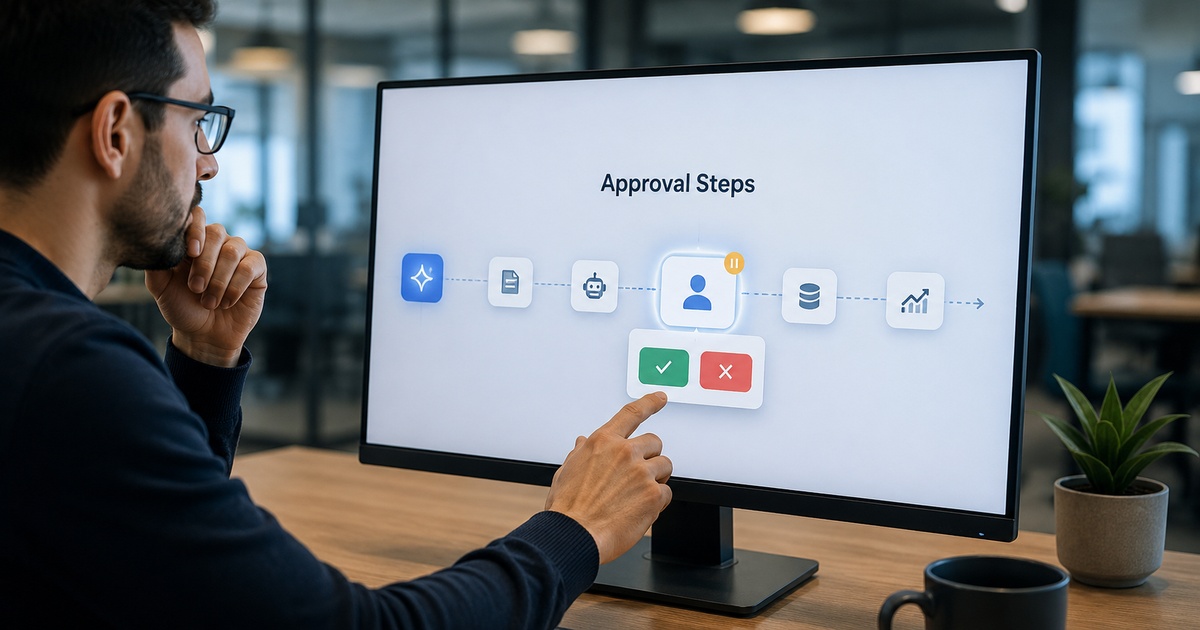
The promise of AI agents is that they act on your behalf; the danger is exactly the same thing. An agent that can send emails, update records, move money, or message customers can also do those things wrong, at speed and at scale, before anyone notices. Human-in-the-loop design is how you get the leverage of agents without the risk of unsupervised mistakes: you decide which actions an agent can take alone and which need a human to approve first. Done well, it catches the costly errors without turning every task into a bottleneck, whichever agent builder you choose. Here is how to draw that line.
Why full autonomy is the wrong default
It is tempting to let an agent run end to end, that is the dream, but full autonomy is the wrong default for anything consequential, because AI agents are probabilistic. They can misread context, act on a wrong assumption, or simply make things up, and unlike a deterministic workflow, the same situation will not always produce the same result. For low-stakes, easily reversible work, that is fine. For actions that touch customers, money, data, or reputation, an unchecked mistake can be expensive and hard to undo. Starting with approval steps and removing them as trust is earned is far safer than the reverse.
Where approval steps belong
The rule of thumb is to require human approval wherever an action is consequential, irreversible, or hard to verify after the fact.
- External communication: anything sent to customers, prospects, or partners, where a wrong or off-tone message has real consequences.
- Money and contracts: payments, refunds, pricing, or anything with financial or legal weight.
- Irreversible changes: deleting data, closing accounts, or actions that are hard to walk back.
- Sensitive data: anything touching personal, financial, or confidential information.
- Low-confidence decisions: cases the agent itself is unsure about, which it should flag for a human.
Where agents can run alone
Approval everywhere defeats the purpose, so it is just as important to identify where an agent can act unsupervised. Low-stakes, reversible, internal, or easily verified actions are good candidates: drafting (not sending) a reply for review, tagging and sorting, summarising, pulling together research, updating low-risk internal fields. The test is simple, if the worst case of the agent getting it wrong is minor and easily fixed, let it run; if the worst case is costly or hard to undo, gate it. This is the same judgement that underpins designing AI assistant workflows that operators can actually trust.
Designing approvals that do not bottleneck
The art is adding review without recreating the manual work you were trying to remove. A few principles help: batch approvals so a person reviews several at once rather than being interrupted constantly; make the approval lightweight, a clear summary and a one-tap approve or reject where the agent did the heavy lifting; and route approvals to the right person without ceremony. The agent should do the work and present it for a quick yes or no, so the human is approving, not redoing. Get this wrong and people rubber-stamp without reading, which is worse than no review at all; get it right and you keep most of the speed with a real safety net.
Building trust over time
Human-in-the-loop is not a permanent tax; it is a trust-building mechanism. Start an agent with approvals on its consequential actions, watch how it performs, and where it proves reliable on a particular kind of decision, you can loosen the gate, perhaps approving only low-confidence cases or auditing a sample rather than every action. Where it makes mistakes, you keep the human firmly in place. Over time you end up with a calibrated system: the agent runs freely where it has earned trust and pauses where it has not. That graduated approach, tightening and loosening based on evidence, is the heart of safe agent adoption, and it pairs naturally with a solid security review before you ever switch an agent on.
A practical starting policy
If you want a default to begin with rather than designing from scratch, a simple two-tier policy works for most teams. Tier one is “draft only”: for anything that communicates externally, touches money, or changes data in hard-to-reverse ways, the agent prepares the action and a human approves before it happens, every time, at the start. Tier two is “act freely”: for internal, reversible, low-stakes work, summarising, tagging, drafting for later review, the agent acts and you spot-check rather than approve each one.
Start every new agent in this conservative posture, then adjust based on what you actually observe. Where the agent proves consistently reliable on a specific tier-one action, you can graduate it, perhaps to approving only the cases it flags as uncertain, or auditing a sample. Where it makes mistakes, it stays gated, or moves back. Writing the policy down, even informally, matters: it means approvals are deliberate rather than ad hoc, and everyone knows which actions are supervised and which are not, which is exactly the clarity that prevents both reckless autonomy and approval fatigue.
Frequently asked questions
What does human-in-the-loop mean for AI agents?
Human-in-the-loop means an AI agent pauses for a person to review and approve certain actions before they happen, rather than acting fully autonomously. You decide which actions the agent can take alone and which require sign-off, typically gating anything consequential, irreversible, or sensitive. It lets you capture the speed of agents while keeping a human check on the decisions where a mistake would be costly or hard to undo.
Which AI agent actions need human approval?
Require approval for actions that are consequential, irreversible, or hard to verify afterward: external communication with customers or partners, anything involving money or contracts, irreversible changes like deletions, actions touching sensitive data, and any decision the agent itself is low-confidence about. Low-stakes, reversible, internal, or easily checked actions, like drafting, tagging, or summarising, can usually run without approval.
How do I add approvals without slowing everything down?
Make the human approve rather than redo: have the agent do the work and present a clear summary for a quick yes or no. Batch approvals so a person reviews several at once instead of being constantly interrupted, keep each approval lightweight, and route it to the right person. Over time, loosen the gate where the agent proves reliable and tighten it where it errs, so review focuses on the cases that genuinely need it. The goal is a calibrated system that keeps most of the speed of automation while retaining a real human check exactly where a mistake would actually hurt the business, and not where it would simply slow down safe, routine work.

Written by gautam995576@gmail.com
AI automation editor focused on workflow design, tool selection, privacy checks, and operational clarity.
Related automation guides

Security Review Checklist Before Buying an AI Tool
A practical security review checklist for any AI tool before you buy: data handling, access, retention, compliance, and the questions vendors should…
AI Assistant Workflow Design for Busy Operators
How busy operators can design AI assistant workflows that actually save time, choosing the right tasks, setting guardrails, and keeping a human…

Lindy, Gumloop, Relay, and Bardeen: AI Agent Builder Buyer Guide
A buyer's guide to AI agent builders like Lindy, Gumloop, Relay, and Bardeen: how they differ, what to evaluate, and which fits…